

Can a Motion Sensor Lamp Holder Save Energy in Hallways and Stairwells
2026-11-02
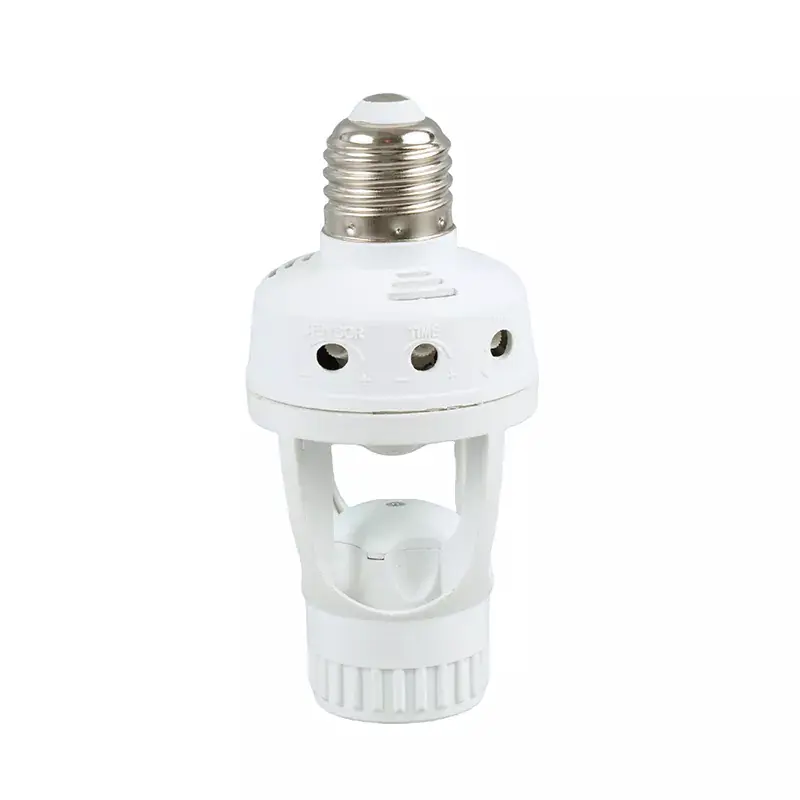
Hallways and stairwells are among the most overlooked energy drains in residential and commercial buildings, running lights for hours even when nobody passes through. A Motion Sensor Lamp Holder from Aipulan addresses this problem directly by combining presence detection with automatic switching, so illumination appears only when movement is detected. This article examines how Aipulan Motion Sensor Lamp Holders deliver measurable savings, what installation factors influence performance, and how to choose the right configuration for your space.
Why Hallways and Stairwells Waste So Much Energy
These transitional areas share three characteristics that make conventional lighting inefficient:
-
Intermittent occupancy – a corridor may be used for only a few minutes per hour.
-
Constant illumination habits – occupants rarely switch off lights in passage areas.
-
Extended operating hours – stairwells often stay lit overnight for perceived safety.
According to energy modeling commonly cited in building retrofits, lighting in circulation spaces can account for 20–30% of a property's lighting electricity use. Replacing manual switching with automatic detection is therefore one of the highest-return, lowest-effort upgrades available.
How a Motion Sensor Lamp Holder Reduces Consumption
An Aipulan Motion Sensor Lamp Holder integrates a PIR (passive infrared) sensor, control circuitry, and a lamp socket into a single unit. The operating logic is straightforward:
-
The PIR sensor detects infrared radiation changes caused by a moving person.
-
The control circuit closes the power supply and the lamp switches on.
-
A preset timer keeps the light on while movement continues.
-
After the hold time expires with no detection, the lamp switches off automatically.
Because the sensor and socket share one housing, there is no separate switch, controller, or additional wiring run—reducing both material cost and installation labor.
Energy Saving Comparison
| Lighting Scenario | Daily Operating Hours | Annual Consumption (10W LED) | Relative Cost |
|---|---|---|---|
| Manual switch, frequently left on | 24 | 87.6 kWh | 100% |
| Manual switch, disciplined use | 8 | 29.2 kWh | 33% |
| Aipulan Motion Sensor Lamp Holder (typical corridor traffic) | 2.5 | 9.1 kWh | ~10% |
Figures assume a 10W LED lamp and 365 days of operation; actual results vary with traffic patterns and hold-time settings.
The table illustrates the core value proposition: automatic detection removes human error from the equation. Even well-intentioned occupants forget to switch off corridor lights, whereas an Aipulan Motion Sensor Lamp Holder enforces the off state by default.
Key Selection Criteria
Choosing the correct unit determines whether savings materialize. Consider the following:
-
Detection range and angle – match coverage to corridor width; a 120° detection angle suits most stairwells.
-
Hold-time adjustability – 10 seconds to 5 minutes covers most circulation areas; longer delays waste energy.
-
Ambient light threshold – a built-in photocell prevents activation during daylight hours.
-
Load compatibility – confirm LED and CFL compatibility to avoid flicker or premature failure.
-
IP rating – outdoor or semi-exposed stairwells require appropriate ingress protection.
Aipulan offers Motion Sensor Lamp Holders with adjustable hold time, dusk-to-dawn override, and broad lamp compatibility, allowing specifiers to tune each unit to the actual traffic profile of the space.
Installation and Commissioning Notes
-
Mount the sensor at 1.8–2.5 m height for reliable detection in corridors.
-
Avoid positioning near HVAC vents or heat sources, which can trigger false activations.
-
Set the hold time to the shortest interval that prevents lights switching off while occupants are still present.
-
Verify that the lamp wattage stays within the holder's rated load.
Frequently Asked Questions
Q: Can a Motion Sensor Lamp Holder work with LED bulbs?
A: Yes. Aipulan Motion Sensor Lamp Holders are designed for LED, CFL, and incandescent lamps, provided the total wattage remains within the rated load; LED lamps are recommended because they combine low consumption with long service life and produce less heat that could interfere with PIR detection.
Q: How much energy can one unit realistically save in a stairwell?
A: Savings depend on traffic and baseline behavior, but replacing continuous operation with detection-based switching typically reduces stairwell lighting energy by 70–90%, since the lamp is only active during actual occupancy rather than around the clock.
Q: Does the sensor work through doors or detect people in adjacent rooms?
A: No. PIR detection requires a direct line of sight and responds only to moving infrared sources within the sensor's field of view, so walls and closed doors block detection and prevent unwanted switching in neighboring spaces.
Conclusion
For hallways and stairwells, the combination of intermittent occupancy and habitual over-illumination makes Aipulan Motion Sensor Lamp Holders a genuinely effective energy-saving solution. By automating the on/off cycle, these units eliminate waste without sacrificing safety or convenience—and they install in minutes using existing lamp holders.
Ready to cut circulation-lighting costs in your building? Contact us today to discuss your project requirements, request a sample, or receive a tailored recommendation from the Aipulan team.