
Why Does Pendant Track Lighting Suit High Ceilings?
2026-09-28
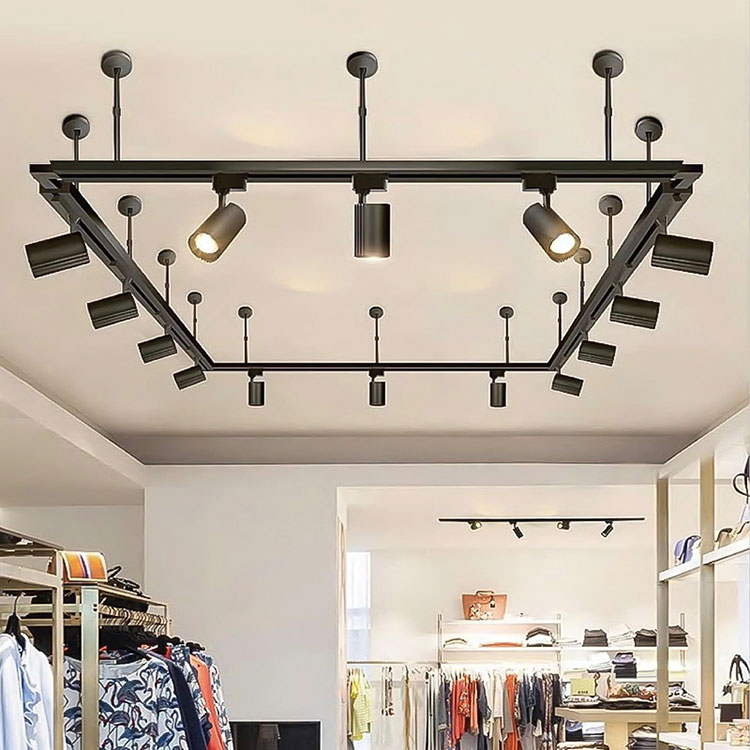
In a space with a ceiling height of 8 meters, a standard track head mounted directly on the track delivers most of its light into the upper air. The floor receives only a fraction of the lumens that the same fixture would deliver in a room with a 3-meter ceiling. The result is a dim, uneven, and uncomfortable environment—not because the fixture is underpowered, but because the mounting height and beam angle are mismatched. Pendant Track Lighting solves this problem by suspending the fixture closer to the task plane and by using a narrower beam angle to concentrate the light where it is needed. This guide explains the optics and the practical design rules for high-ceiling applications.
1. How Does Mounting Height Affect Illuminance on the Floor?
The illuminance on the floor is inversely proportional to the square of the distance from the light source. This is the inverse square law. If you double the distance from the source to the floor, the illuminance drops to one quarter. In a high-ceiling space, the distance from the ceiling-mounted fixture to the floor is large, so the illuminance is low. A pendant fixture reduces that distance by suspending the light source below the ceiling. The table below shows the illuminance at floor level for different mounting heights and beam angles.
| Mounting height | Beam angle | Illuminance at floor (lux) | Coverage diameter |
| 8 m (ceiling mounted) | 60° | 85 | 9.2 m |
| 8 m (ceiling mounted) | 25° | 420 | 3.5 m |
| 5 m (pendant) | 60° | 220 | 5.8 m |
| 5 m (pendant) | 25° | 1,080 | 2.2 m |
| 4 m (pendant) | 25° | 1,690 | 1.8 m |
The data shows that a pendant fixture at 5 meters with a 25-degree beam delivers five times the illuminance of a ceiling-mounted fixture at 8 meters with a 60-degree beam. This is why Pendant Track Lighting is preferred for high-ceiling spaces: it allows the designer to achieve the required illuminance with fewer fixtures and lower total wattage. In our factory, we manufacture Track Lighting fixtures with interchangeable beam angles from 15 to 60 degrees, so the designer can optimize the beam for the specific mounting height.
2. Why Does Beam Angle Matter More in High-Ceiling Spaces?
The beam angle determines the spread of the light and the intensity at the center of the beam. In a high-ceiling space, a wide beam angle produces a large pool of dim light, while a narrow beam angle produces a smaller pool of bright light. For general illumination, a narrow beam is usually preferred because it delivers more useful light to the floor and less light to the walls and upper air. For accent lighting, an even narrower beam (10 to 15 degrees) is used to highlight specific objects. The table below shows the recommended beam angles for different high-ceiling applications.
| Application | Ceiling height | Recommended beam angle | Mounting method |
| Warehouse aisle | 6 – 10 m | 25° – 40° | Pendant, 1.5 – 2.0 m drop |
| Retail atrium | 8 – 12 m | 15° – 25° | Pendant, 2.0 – 3.0 m drop |
| Industrial inspection | 4 – 6 m | 15° – 20° | Pendant, 1.0 – 1.5 m drop |
| Hotel lobby | 5 – 8 m | 20° – 30° | Pendant, 1.5 – 2.5 m drop |
| Exhibition hall | 6 – 12 m | 10° – 20° | Pendant, 2.0 – 3.5 m drop |
Zhongshan Dadi Lighting Technology Co., Ltd. manufactures Track Lighting fixtures with field-interchangeable lenses and reflectors. Our factory also provides photometric files (IES) for each beam angle so that the designer can simulate the illuminance before installation. This reduces the risk of under-lighting or over-lighting the space.
3. How Does Pendant Mounting Improve Glare Control?
Glare is a significant problem in high-ceiling spaces because the light source is often in the field of view. A ceiling-mounted fixture at 8 meters may be visible to a person standing 10 meters away, and the bright source can cause discomfort. A pendant fixture can be equipped with a deep reflector or a honeycomb louver that shields the source from normal viewing angles. The pendant mounting also allows the fixture to be positioned so that the light is directed downward and away from the eyes. The table below shows the glare rating (UGR) for different mounting and shielding configurations.
| Configuration | UGR (glare rating) | Visual comfort | Recommended application |
| Ceiling-mounted, no shield | 28 | Poor | Non-occupied spaces |
| Ceiling-mounted, with diffuser | 22 | Fair | Warehouse |
| Pendant, deep reflector | 16 | Good | Retail, atrium |
| Pendant, honeycomb louver | 13 | Excellent | Office, inspection |
In our factory, we offer Pendant Track Lighting fixtures with a range of glare control accessories. The deep reflector is the most common option for high-ceiling applications because it provides good glare control without significantly reducing the beam efficiency. The honeycomb louver provides the best glare control but reduces the lumen output by 15 to 20 percent, so it is used in applications where visual comfort is the priority.
4. What Are the Maintenance and Installation Advantages of Pendant Track Lighting?
Maintenance in a high-ceiling space is expensive. A scissor lift or a scaffolding is required to reach the fixture. Pendant Track Lighting reduces the maintenance cost in two ways. First, the fixture is suspended lower, so it is easier to reach. Second, the track system allows the fixtures to be repositioned or replaced without rewiring. If a fixture fails, it can be unplugged from the track and replaced in minutes. The table below compares the maintenance effort for ceiling-mounted and pendant track systems.
| Maintenance task | Ceiling-mounted track | Pendant Track Lighting |
| Lamp replacement height | 8 m (ceiling level) | 5 m (pendant level) |
| Time to replace one fixture | 45 – 60 minutes | 10 – 15 minutes |
| Equipment required | Scissor lift or scaffold | Step ladder (for lower pendants) |
| Rewiring required for relocation | Yes | No (plug-in track) |
Design tip: For high-ceiling spaces, specify a pendant drop length that places the bottom of the fixture at least 0.5 meters below the ceiling. This improves light distribution and allows the maintenance team to reach the fixture with a standard ladder instead of a lift.
Frequently Asked Questions About Pendant Track Lighting for High Ceilings
Summary for Lighting Designers and Facility Managers
Pendant Track Lighting is the preferred solution for high-ceiling spaces because it reduces the mounting height, which increases the illuminance on the floor according to the inverse square law. It allows the use of narrower beam angles, which concentrate the light where it is needed. It improves glare control through deep reflectors and louvers. And it reduces maintenance costs because the fixtures are easier to reach and can be relocated without rewiring. For spaces with ceilings above 6 meters, the pendant configuration is almost always the better choice. Zhongshan Dadi Lighting Technology Co., Ltd. has been manufacturing Track Lighting fixtures for over 12 years and provides full photometric data and design support.
Zhongshan Dadi Lighting Technology Co., Ltd. manufactures Pendant Track Lighting fixtures with interchangeable beam angles, glare control accessories, and heavy-duty track systems. We provide IES files and lighting design services for high-ceiling applications.